

By Christina Morton
Christina is the founder of The Organizing Company and has been organizing professionally since 2013. She is currently grateful for coworking days with friends, walks at Majestic View Park, and Liquid I.V. Energy.
No A.I. copy & paste here! All our blogs are still written by professional organizers or other humans.
Affiliate Disclosure: Some of the links on our website are affiliate links, meaning, at no additional cost to you, we will earn a commission if you click through and make a purchase.
We might still get a snow or two in the next month, but for the most part, winter is over. Which means you can start transitioning to your summer set-up in your garage to make room for all the summer activities!
Now, some of you might not even need to do a “seasonal swap" in your garage. You might be able to leave things in the same place all year round because they can be easily accessed all year round. If that's you, woohoo! You can just take the time to make some tweaks or do a little tune up.
But if you're reading this and thinking, “Yeah, there's no way I can access my gardening stuff right now," (or kids yard toys, or golf clubs, or whatever it is you and your family do in the summer), then this one is for you.
The whole idea of seasonal swaps, as I call them, is that you make what is most used for the current season most accessible, and relocate off-season items to harder to reach areas.
Skis and snowboards (and all the boots, goggles, helmets, that go with them) are on their way out.
Sleds and snowball makers (IYKYK) are done.
Snowblower? Let's hope you don't need that in July.
But you do want to be able to easily access the sprinkler and kites for the kids, and your summer bike, and the lawn mower.
If you have seasonal hobbies, or just more stuff than your space can comfortably fit, then a seasonal swap is the way to go.
Here is an easy checklist to help you go through the garage and determine what needs to move to more prime real estate.
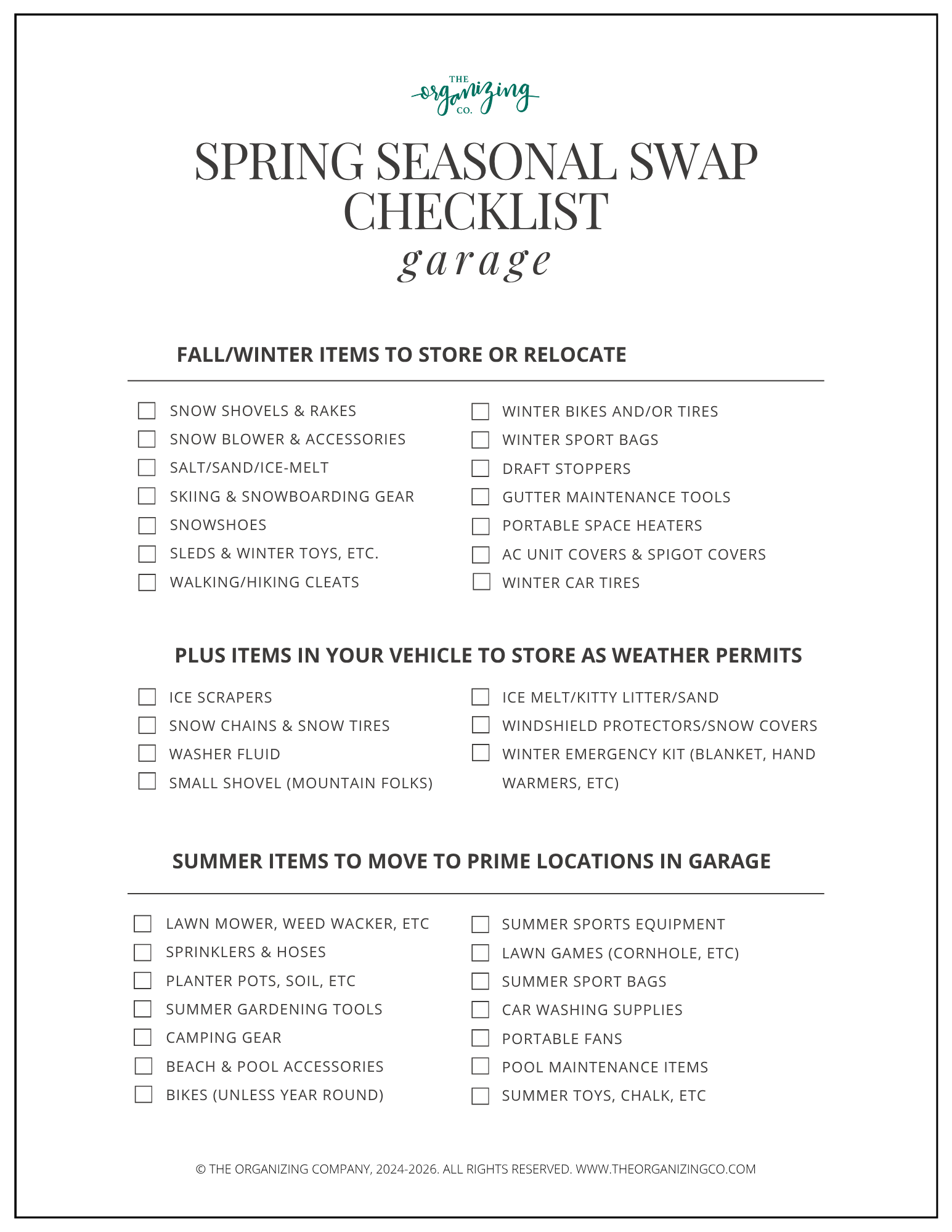
Does your garage need more than some quick swaps?
Assess what level of work your garage needs. If you're already relatively organized, you can just make a few swaps from up high to down low, etc. If you're thinking that's madness and you have no clue where to start even after glancing at that checklist, your garage probably needs more of an overhaul than just seasonal swaps.
If that's you, no judgment, just start by going through the full organizing process in your garage. As you're setting it up in Step 4, consider if you'll need to do seasonal swaps in the future and make choices that will support that.
Here's the link to a guide through my organizing process so you can get your garage ready for summer and beyond.
Whether you’re sticking with some organized swaps, or you’re doing a full overhaul, here are some best practices for organizing your garage:
Be mindful of what you want your kids to reach- and not reach
Empower and train your kids to get and put back their own stuff. Choose homes for their toys/sport bags/etc that are safe, easy to access at their level, and clearly labeled.
Remember to keep chemicals, sharp objects, and anything else that might be dangerous away from where your kids can reach until they are old enough. Make sure there isn’t anything that can easily fall over if they bump into it or pull something else off the shelf near it.
Create zones for broad categories
Think of your local home improvement store. There is a painting section, shelving, storage, hardware, hand tools, power tools, lawn care/gardening, grilling, cleaning, etc. You want to create similar categories and space plan them in your garage so that what you use most is easiest to access. Most people use hand tools and power tools the most and things like painting and tiling supplies are less frequent, for example.
The idea is to have what you need to do a project grouped together, with the only exceptions being the hand/power tools you may need that are multi-purpose and should be kept with their broader category.
Don’t forget sporting goods, camping, auto care, etc. If you’re super outdoorsy, think of a Cabela’s or REI for what types of categories you can create to get you started.
There are no right or wrong categories necessarily. It’s based on your stuff and how you use it. Most people might use a headlamp for camping, but you may primarily have it for walking your dog in the dark. In that case I would put it with dog walking items not camping. You get the idea.
Use your vertical space wisely
We ask a lot of our garages, so maximizing them is usually key. We all know that we should use our vertical space, but there are a few mistakes I see often enough as an Organizer that they are worth mentioning:
-Consider the weight of what you’re putting up high. Who will be accessing this? How often will it be accessed? Can the shelf/items below it support the weight? In general, I avoid putting heavy things up high whenever possible.
-Use shelves instead of simply stacking. Neither boxes nor plastic bins last very long stacked directly on top of each other. I’ve seen many a plastic tote warped, cracking, and caved in because of the heat and weight of totes stacked on top of it. For temporary purposes, fine. But for long term storage, use a storage rack or shelving of some kind, especially if the boxes/bins are accessed more than once a year. It’ll be safer and it’ll make your life a lot easier when you need something in the bottom bin.
Things to avoid storing in your garage:
Unless you have an actual heater and wall AC unit (swamp coolers don’t cut it, folks), your garage temperature varies too much to be safe for the following items:
Paint- Why keep it if it won’t be any good when you’re ready to use it again? Keeping it in the garage will probably ruin paint. So store it indoors in a crawlspace or utility room or under the stairs.
Grout- It’s less than ideal due to extreme temperatures and the potential moisture associated with that. Store wherever you store your paint indoors.
Propane tanks & other fuel/gasoline- The vapors are an issue (especially in hot temperatures) and may ignite if something else in the garage sparks. Store these outside in the shade, away from ignition sources, and at least 10 feet from your home.
Photographs & keepsakes- These should go in a basement or other indoor area in waterproof bins. Heat makes photos stick together and they get destroyed. Also water and pests are notorious destroyers of precious pictures and baby clothes in garages.
Electronics- Anything you care about should be stored indoors.
Canned carbonated drinks- pop can’t handle freezing and I find exploded cans.
Also, avoid storing food of any kind in the garage because it may attract mice/rats. I’ll never forget my first summer as an Organizer when I found a stash of canned goods in a garage with a dead mouse stuck in the juice that had oozed from one of them somehow. At least it died happy…?
Last tips for making a spring swap:
Think through your plan: Where are you moving the off season stuff?
For some of you, you can just move the bins of kids toys down and put the bins of snowshoes and ski boots up higher. Same with items that hang on the wall: camping chairs can swap to the lower hooks and snow shovels can go back up on the higher hooks.
But if you need to actually physically remove stuff from your garage to make space make sure you are keeping yourself organized so Future You will thank you and not curse you. That means labeling bins/boxes (side note: I always recommend plastic bins to protect from water, dust, and pests) that you send to storage (or put in the attic/crawlspace), covering loose items with a tarp to protect from dust, and keeping all off season items together. Putting some stuff in the shed and some in the attic and some in the crawlspace gets hard to keep track of what's where. Keep it together, or at minimum please put a searchable Note in your phone as a "map" of what went where and keep categories together (ie don't split ski stuff into three locations).
Doing this means that if you need something in the off-season for a trip or some crazy, unseasonably cold weather event you can find it quickly. It also makes it easier to swap stuff back to the garage when you need to.
Just a friendly reminder… as you’re making these seasonal adjustments, make sure you remember to keep things in their “zones” so your garage stays organized overall. For example, you might move your kid’s hockey bag up high on a shelf for the summer and pull down their soccer stuff. Still keep the soccer bag in the sporting goods section with any other sport stuff you may have. If you have the soccer bag in one corner and the bike helmets and pool noodles in another, it will feel less functional and it will be harder for the kids to do their part of putting stuff away if they don’t have one designated for all their sports/activities. It starts to break down the organization. So make sure you keep categories together with their buddies in the same broader zone!
April 23rd, 2026
Share & Follow
